When companies start looking for a software licensing solution, the conversation usually begins with technical requirements: How do we prevent uncontrolled use of our software? Can we support floating licenses? What about offline customers? How do we introduce subscriptions or usage-based licensing? How do we replace our existing homegrown licensing system?
These are all valid questions. A professional licensing system needs reliable activation and validation, flexible licensing models and the required level of security. But after working on licensing projects for many years, we believe these capabilities are only the beginning.
The bigger opportunity is automation. For us at SLASCONE, modern software licensing and entitlement management is about making the commercial lifecycle of a software customer as automated as possible. Once licensing has been integrated into your software, the less manual licensing work your sales, support and engineering teams need to perform, the better.
THE REAL COMPLEXITY APPEARS LATER
Most licensing evaluations initially focus on activation, validation, APIs, SDKs, offline support and licensing models. The real complexity, however, often appears later.
- A customer renews.
- Another customer upgrades from one edition to another.
- A customer purchases additional users or devices.
- A trial becomes a production subscription.
- A customer adds another module or feature.
- A reseller needs to manage licenses for its own customers.
At that point, the licensing challenge is no longer primarily about whether an application can validate a license. It is about operating the commercial relationship with the customer efficiently.
FROM A LICENSING FEATURE TO A LICENSING OPERATING MODEL
This is why we prefer to think about a licensing operating model, rather than simply a licensing feature.
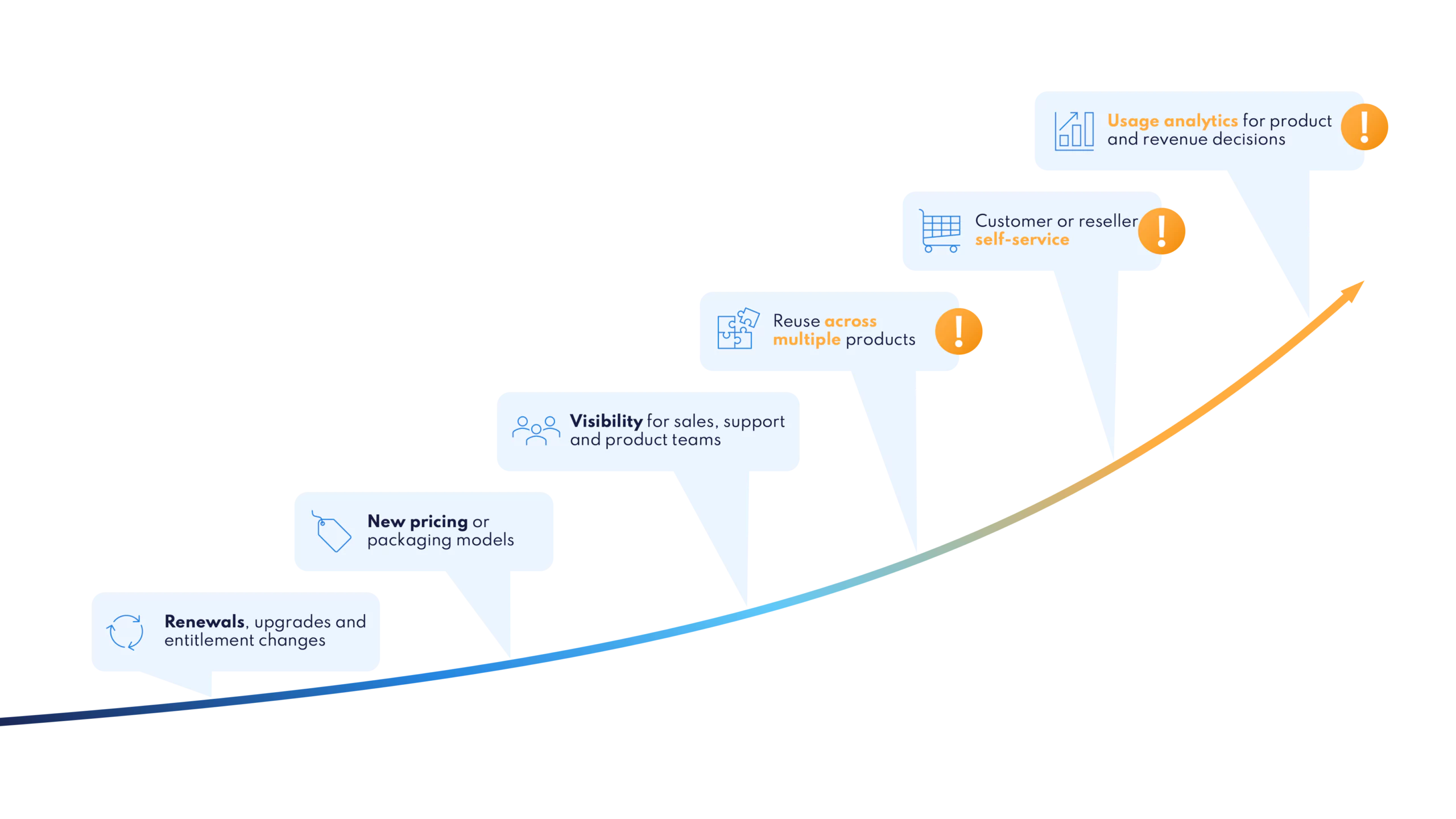
Consider a typical software customer lifecycle: evaluation, purchase, provisioning, usage, renewal, upgrade or downgrade, and expansion. Every transition can create manual work.
Someone may need to create the evaluation license. When the prospect becomes a customer, somebody changes the entitlement. When additional users are purchased, somebody updates a limit. At renewal, somebody extends the subscription. When the customer upgrades, somebody enables additional features.
You can operate licensing this way, but ideally you should not have to.
The desired outcome is not that somebody knows how to change a licensing parameter. The desired outcome is that nobody has to.
LICENSING AS AN AUTOMATION LAYER
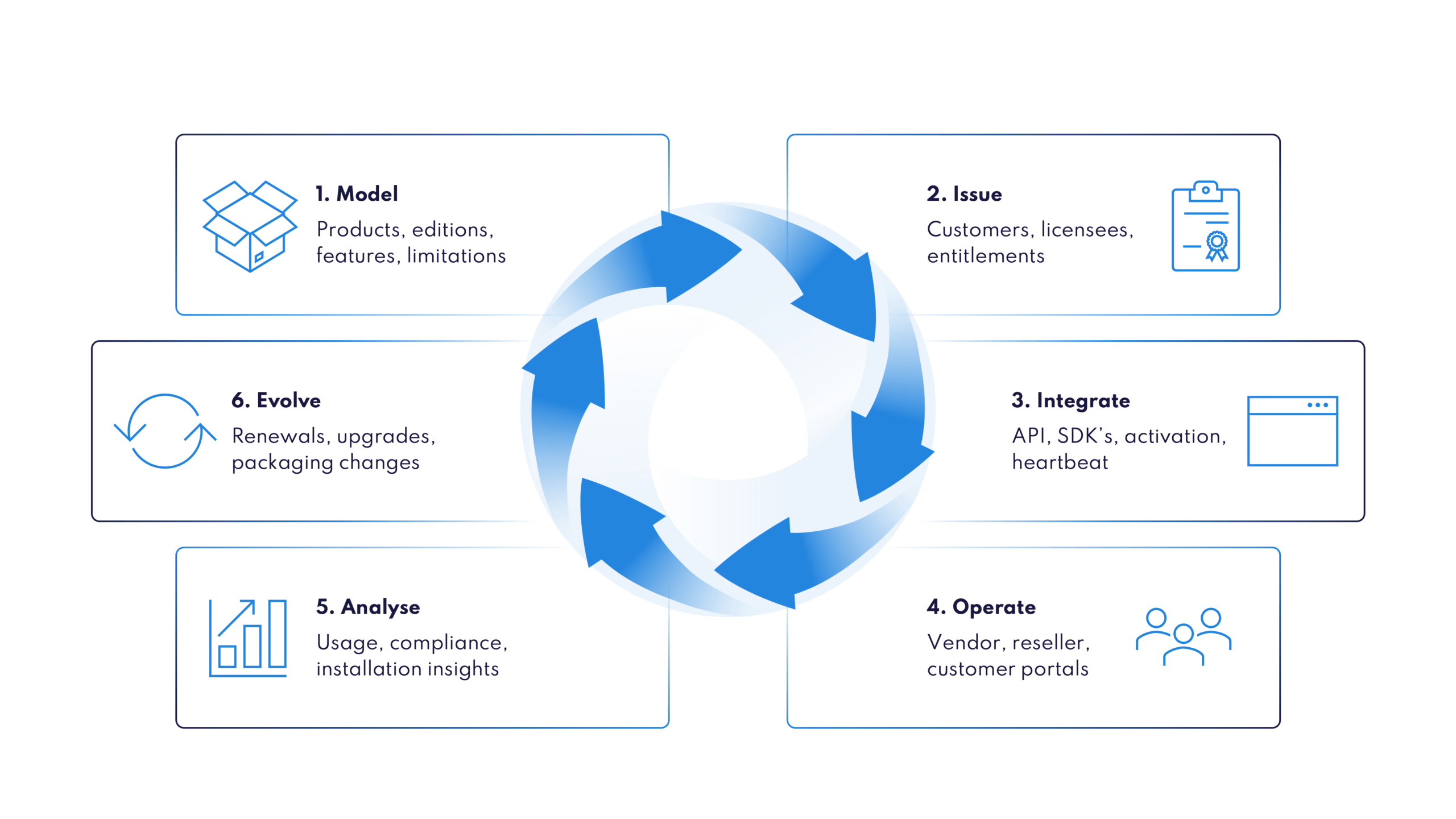
A useful way to think about modern licensing is as the connection between your commercial systems and your software. Your CRM knows who the customer is. Your ERP, billing platform or e-commerce system knows what the customer purchased. Your software needs to know what the customer is entitled to use.
Licensing connects these worlds.
This is how we describe SLASCONE’s licensing and entitlement management platform: as the licensing and analytics layer between your software, your commercial model and your customers. More importantly, we see that layer as an automation layer.
A closed opportunity can create an entitlement. A purchase can activate a product edition. A renewal can extend access. An upgrade can unlock additional functionality. A downgrade can change the entitlement at the appropriate date. A cancellation can schedule expiration. Usage information can flow back into analytics and commercial processes.
The exact workflow differs between software companies. The principle does not: the licensing state should follow the commercial relationship as automatically as possible.
AUTOMATING THE CUSTOMER LIFECYCLE
Take an evaluation as a simple example. A prospect requests a trial. In an automated setup, this can create the necessary customer and entitlement automatically, including the appropriate edition, features, limitations and expiration date.
If the prospect becomes a paying customer, the commercial system triggers the next change. The evaluation becomes a production entitlement, the expiration changes and additional functionality may become available. The customer simply continues using the software.
The same principle applies throughout the lifecycle. If a customer moves from Standard to Professional, the commercial transaction should ideally be enough to update the entitlement. If a subscription grows from 100 to 150 users, the corresponding limit should change automatically. If the customer renews, there should be no reason for somebody to manually extend a license.
This requires integration. A licensing platform should not be an isolated system that administrators maintain manually. It needs to connect with the systems that already run the business, whether that is a CRM, ERP, billing platform, e-commerce system, workflow engine or your own backend.
This is why an API-first approach is central to SLASCONE. The licensing system becomes part of the broader business workflow rather than another administrative silo.
SELF-SERVICE IS ALSO AUTOMATION
Automation does not always require a system-to-system integration. Sometimes the best automation is allowing the right person to perform an operation without involving your own organization.
A customer portal can allow licensees to manage assignments, access licenses or perform selected administrative operations themselves. A reseller portal can allow partners to provision and manage entitlements for their own customers within clearly defined permissions.
Instead of a customer contacting support, an internal employee processing the request and finally changing something in the licensing system, the customer or reseller can perform the appropriate operation directly.
For many software vendors, reducing this operational workload becomes just as valuable as the licensing technology itself.
SECURITY IS THE FOUNDATION, NOT THE END GOAL
None of this means that licensing security is unimportant. Reliable activation and validation, protection against uncontrolled usage, offline licensing, floating license management, availability and operational security remain fundamental requirements.
They are the foundation on which automation is built.
But we do not believe that licensing solutions should be evaluated simply by counting technical features. Having another twenty configuration options does not automatically create more business value.
A more useful evaluation should also consider questions such as:
- How many routine licensing operations can happen automatically?
- How often will sales or support need help from engineering?
- Can commercial changes be reflected in the software without manually editing a license?
- Can customers and resellers perform appropriate operations themselves?
- Can the licensing model evolve when pricing and packaging change?
These questions often become more important over the lifetime of a licensing platform than another checkbox in a technical feature comparison.
FROM DIGITIZED LICENSING TO AUTOMATED LICENSING
Replacing manually generated license files or a homegrown licensing server with a professional licensing platform is already an important step. But there is a second step that is easy to overlook.
Digitizing licensing is not the same as automating licensing.
You can have a modern licensing portal and still manually create every evaluation. You can have a cloud licensing API and still manually process every renewal. You can model sophisticated entitlements and still rely on support for every upgrade.
The real transformation happens when licensing becomes part of your operational workflows: commercial events produce entitlement changes, the licensing state reflects the current customer relationship, and the software reacts to those changes automatically.
That is the approach we take at SLASCONE.
Software licensing should protect your commercial model. But more importantly, it should help you operate that model efficiently.
For us, that means putting automation at the center of software licensing and entitlement management.